Linear Model Selection
Linear Model Selection Example 2.1
For the Credit example, we begin with the so-called null model , which contains no predictors:
Then, we add a predictor variable to the null model. For this example, we will write two Python-functions, one to fit a linear model and return important scoring metrics and one to add one predictor to a model, based on the returned scores.
import pandas as pd
import numpy as np
import statsmodels.api as sm

# Load data
df = pd.read_csv('Linear Model Selection/data/Credit.csv')

# Convert Categorical variables
df = pd.get_dummies(data=df, drop_first=True,
                    prefix=('Gender_', 'Student_',
                            'Married_', 'Ethnicity_'))

x_full = df.drop(columns='Balance')
y = df['Balance']


def fit_linear_reg(x, y):
    '''Fit Linear model with predictors x on y
    return AIC, BIC, R2 and R2 adjusted '''
    x = sm.add_constant(x)
    # Create and fit model
    model_k = sm.OLS(y, x).fit()

    # Find scores
    BIC = model_k.bic
    AIC = model_k.aic
    R2 = model_k.rsquared
    R2_adj = model_k.rsquared_adj
    RSS = model_k.ssr

    # Return result in Series
    results = pd.Series(data={'BIC': BIC, 'AIC': AIC, 'R2': R2,
                              'R2_adj': R2_adj, 'RSS': RSS})

    return results


def add_one(x_full, x, y, scoreby='RSS'):
    ''' Add possible predictors from x_full to x,
    Fit a linear model on y using fit_linear_reg
    Returns Dataframe showing scores as well as best model '''
    # Predefine DataFrame
    x_labels = x_full.columns
    zeros = np.zeros(len(x_labels))
    results = pd.DataFrame(
        data={'Predictor': x_labels.values, 'BIC': zeros,
               'AIC': zeros, 'R2': zeros,
               'R2_adj': zeros, 'RSS': zeros})

    # For every predictor find R^2, RSS, and AIC
    for i in range(len(x_labels)):
        x_i = np.concatenate((x, [np.array(x_full[x_labels[i]])]))
        results.iloc[i, 1:] = fit_linear_reg(x_i.T, y)

    # Depending on where we scoreby, we select the highest or lowest
    if scoreby in ['RSS', 'AIC', 'BIC']:
        best = x_labels[results[scoreby].argmin()]
    elif scoreby in ['R2', 'R2_adj']:
        best = x_labels[results[scoreby].argmax()]

    return results, best


# Define the empty predictor
x_empty = [np.zeros(len(y))]

results, best1 = add_one(x_full, x_empty, y)

print(results[['Predictor', 'AIC', 'R2', 'RSS']],
      '\n\nBest predictor is:',  best1)
Predictor AIC R2 RSS
0 Unnamed: 0 6042.696603 0.000037 8.433681e+07
1 Income 5945.894250 0.214977 6.620874e+07
2 Limit 5499.982633 0.742522 2.171566e+07
3 Rating 5494.781548 0.745848 2.143512e+07
4 Cards 6039.710202 0.007475 8.370950e+07
5 Age 6042.709965 0.000003 8.433963e+07
6 Education 6042.685316 0.000065 8.433443e+07
7 Gender__Female 6042.526817 0.000461 8.430102e+07
8 Student__Yes 6014.932656 0.067090 7.868154e+07
9 Married__Yes 6042.698437 0.000032 8.433720e+07
10 Ethnicity__Asian 6042.672799 0.000096 8.433179e+07
11 Ethnicity__Caucasian 6042.706987 0.000011 8.433900e+07
Best predictor is: Rating
We will save the definition used in a helper file, LMS_def.py.
We now choose the best variable in the sense that adding this variable leads to the regression model with the lowest RSS or the highest . The variable that results in the model with the lowest RSS is in this case rating.
Thus, we have found the model
We now add a further predictor variable to this model by first updating the reference model and removing the chosen predictor from the set of possible predictors. Subsequently, we can run the same procedure and decide which predictor variable to add next.
# Update the empty predictor with the best predictor
x_1 = [df[best1]]
# Remove the chosen predictor from the list of options
x_red = x_full.drop(columns=best1, errors='ignore')

results, best2 = add_one(x_red, x_1, y)

print(results[['Predictor', 'AIC', 'R2', 'RSS']],
      '\n\nBest predictor is:',  best2)
Predictor AIC R2 RSS
0 Unnamed: 0 5496.518489 0.746016 2.142103e+07
1 Income 5212.557085 0.875118 1.053254e+07
2 Limit 5496.632982 0.745943 2.142716e+07
3 Cards 5494.187124 0.747492 2.129654e+07
4 Age 5484.481339 0.753545 2.078601e+07
5 Education 5496.272851 0.746171 2.140788e+07
6 Gender__Female 5496.481640 0.746039 2.141906e+07
7 Student__Yes 5372.232473 0.813849 1.569996e+07
8 Married__Yes 5494.569548 0.747250 2.131691e+07
9 Ethnicity__Asian 5496.067431 0.746302 2.139689e+07
10 Ethnicity__Caucasian 5496.772749 0.745854 2.143465e+07
Best predictor is: Income
We select again the variable that leads when added to the reference model to the lowest RSS. In this case, we select the predictor variable income which gives us the model :
This procedure will be repeated. In particular, we will add one variable among the remaining variables to the model . The resulting model with the lowest RSS will become model .
# Update the empty predictor with the best predictor
x_2 = np.concatenate((x_1, [df[best2]]))
# Remove the chosen predictor from the list of options
x_red = x_red.drop(columns=best2, errors='ignore')

results, best3 = add_one(x_red, x_2, y)

print(results[['Predictor', 'AIC', 'R2', 'RSS']],
      '\n\nBest predictor is:',  best3)
Predictor AIC R2 RSS
0 Unnamed: 0 5214.551863 0.875120 1.053240e+07
1 Limit 5210.950291 0.876239 1.043800e+07
2 Cards 5214.477534 0.875143 1.053045e+07
3 Age 5211.113461 0.876188 1.044226e+07
4 Education 5213.765645 0.875365 1.051172e+07
5 Gender__Female 5214.521087 0.875129 1.053159e+07
6 Student__Yes 4849.386992 0.949879 4.227219e+06
7 Married__Yes 5210.930247 0.876245 1.043747e+07
8 Ethnicity__Asian 5212.042074 0.875901 1.046653e+07
9 Ethnicity__Caucasian 5213.976405 0.875299 1.051726e+07
Best predictor is: Student__Yes
We can automatically select the n-best predictors using SequentialFeatureSelector from sklearn.feature_selection. Therfore, we need to define the Linear model with sklearn.linear_model.LinearRegression. The chosen predictors are returned in the support_ attribute. Note: If None features are selected, the algorithm automatically choses half number of features given.
In this case, the predictor student turns out to be the variable that we add to model to obtain model :
We will end up with the following models: .
But how are we going to identify the best model among these 11 models? We may base our decision on the value of the AIC which is listed in the Python output. This statistic allows us to compare different models with each other. We will later discuss the AIC in greater detail.
The procedure we have followed can also be automated using sklear.feature_selection. However, this is a relatively new package, which is not as flexible or extensive yet.
from sklearn.feature_selection import SequentialFeatureSelector
from sklearn.linear_model import LinearRegression

# define Linear Regression Model in sklearn
linearmodel = LinearRegression()
# Sequential Feature Selection using sklearn
sfs = SequentialFeatureSelector(linearmodel, n_features_to_select=3,
                                direction='forward')
sfs.fit(x_full, y)

# Print Chosen variables
print(x_full.columns[sfs.support_].values)
['Income' 'Rating' 'Student__Yes']
The model with three predictor variables includes the variables income, rating and student.
Linear Model Selection Example 2.2
We begin with the *full model}, that is , which contains all predictors of the \data{Credit} data set
Then we remove one predictor variable from the model.
We create a new function, similar to the add_one function, which removes each predictor separately from the full model. All created functions will be saved in LMS_def, and imported when needed.
import pandas as pd
import numpy as np
from LMS_def import *

# Load data
df = pd.read_csv('Linear Model Selection/data/Credit.csv')

# Convert Categorical variables
df = pd.get_dummies(data=df, drop_first=True,
                    prefix=('Gender_', 'Student_',
                            'Married_', 'Ethnicity_'))

x_full = df.drop(columns='Balance')
y = df['Balance']

def drop_one(x, y, scoreby='RSS'):
    ''' Remove possible predictors from x,
    Fit a linear model on y using fit_linear_reg
    Returns Dataframe showing scores as well as predictor
    to drop in order to keep the best model '''
    # Predefine DataFrame
    x_labels = x.columns
    zeros = np.zeros(len(x_labels))
    results = pd.DataFrame(
        data={'Predictor': x_labels.values, 'BIC': zeros,
               'AIC': zeros, 'R2': zeros,
               'R2_adj': zeros, 'RSS': zeros})

    # For every predictor find RSS and R^2
    for i in range(len(x_labels)):
        x_i = x.drop(columns=x_labels[i])
        results.iloc[i, 1:] = fit_linear_reg(x_i, y)

    # Depending on where we scoreby, we select the highest or lowest
    if scoreby in ['RSS', 'AIC', 'BIC']:
        worst = x_labels[results[scoreby].argmin()]
    elif scoreby in ['R2', 'R2_adj']:
        worst = x_labels[results[scoreby].argmax()]

    return results, worst

results, worst1 = drop_one(x_full, y)

print(results[['Predictor', 'AIC', 'R2', 'RSS']],
      '\n\nWorst predictor is:',  worst1)
Predictor AIC R2 RSS
0 Unnamed: 0 4821.370391 0.955102 3.786730e+06
1 Income 5361.643903 0.826689 1.461702e+07
2 Limit 4853.911857 0.951296 4.107672e+06
3 Rating 4826.005381 0.954578 3.830864e+06
4 Cards 4837.510427 0.953253 3.942650e+06
5 Age 4825.143746 0.954676 3.822621e+06
6 Education 4820.935924 0.955150 3.782619e+06
7 Gender__Female 4821.391825 0.955099 3.786933e+06
8 Student__Yes 5214.259751 0.880104 1.011204e+07
9 Married__Yes 4821.188761 0.955122 3.785011e+06
10 Ethnicity__Asian 4821.918353 0.955040 3.791921e+06
11 Ethnicity__Caucasian 4821.043224 0.955138 3.783634e+06
Worst predictor is: Education
Now we remove the least useful variable which is the one that yields the reduced regression model with the lowest RSS or the highest . This predictor represents the most redundant variable because its removal improves the model most significantly with respect to the RSS. In this case, this is the predictor education.
Thus, we obtain the model which is given by
We now remove another variable from this model. To do so we first need to update the reference model which means dropping the selected predictor from the full set. Subsequently, we run the same procedure again.
# Remove the chosen predictor from the list of options
x_red1 = x_full.drop(columns=worst1, errors='ignore')

results, worst2 = drop_one(x_red1, y)

print(results[['Predictor', 'AIC', 'R2', 'RSS']],
      '\n\nWorst predictor is:',  worst2)
Predictor AIC R2 RSS
0 Unnamed: 0 4819.857603 0.955047 3.791345e+06
1 Income 5359.644014 0.826689 1.461703e+07
2 Limit 4851.966157 0.951290 4.108230e+06
3 Rating 4824.775477 0.954491 3.838246e+06
4 Cards 4835.976056 0.953198 3.947242e+06
5 Age 4823.685440 0.954615 3.827801e+06
6 Gender__Female 4819.862964 0.955046 3.791396e+06
7 Student__Yes 5213.014039 0.879877 1.013112e+07
8 Married__Yes 4819.758863 0.955058 3.790410e+06
9 Ethnicity__Asian 4820.411139 0.954985 3.796596e+06
10 Ethnicity__Caucasian 4819.562597 0.955080 3.788550e+06
Worst predictor is: Ethnicity__Caucasian
Optional:
We could again repeat this procedure until one 1 predictor is left.
# Remove the chosen predictor from the list of options
x_red2 = x_red1.drop(columns=worst2, errors='ignore')

results, worst3 = drop_one(x_red2, y)

print(results, '\n\nWorst predictor is:',  worst3)
Predictor BIC AIC R2 R2_adj \
0 Unnamed: 0 4858.512384 4818.597738 0.954964 0.953924
1 Income 5398.135774 5358.221128 0.826439 0.822434
2 Limit 4890.496911 4850.582266 0.951215 0.950089
3 Rating 4863.290746 4823.376101 0.954422 0.953371
4 Cards 4874.514290 4834.599645 0.953125 0.952044
5 Age 4862.350937 4822.436291 0.954529 0.953480
6 Gender__Female 4858.381505 4818.466860 0.954978 0.953939
7 Student__Yes 5251.005635 5211.090990 0.879854 0.877082
8 Married__Yes 4858.201340 4818.286694 0.954999 0.953960
9 Ethnicity__Asian 4858.336298 4818.421652 0.954983 0.953945
RSS
0 3.798367e+06
1 1.463813e+07
2 4.114563e+06
3 3.844014e+06
4 3.953400e+06
5 3.834993e+06
6 3.797125e+06
7 1.013307e+07
8 3.795415e+06
9 3.796695e+06
Worst predictor is: Married__Yes
Analogue to Example 2.1, We can automatically drop the n-worst predictors using SequentialFeatureSelector from sklearn.feature_selection, setting direction=‘backward’. The chosen predictors are returned in the support_ attribute. Note: If None features are selected, the algorithm automatically choses half number of features given.
We choose the model that has the smallest RSS. This turns out to be the case when we remove the predictor variable Ethnicity_Caucasian from the reference model. We then obtain the model :
We iterate this procedure until no predictor variable is left in the regression model. This iterative procedure yields 11 different models . We identify the best among these models on the basis of the AIC, which we will discuss later.
The selection procedure can also be performed using sklearn.feature_selector
from sklearn.feature_selection import SequentialFeatureSelector
from sklearn.linear_model import LinearRegression

# define Linear Regression Model in sklearn
linearmodel = LinearRegression()
# Sequential Feature Selection using sklearn
sfs = SequentialFeatureSelector(linearmodel, n_features_to_select=3,
                          direction='backward')
sfs.fit(x_full, y)

# Print Chosen variables
print(x_full.columns[sfs.support_].values)
['Income' 'Limit' 'Student__Yes']
The regression model with three predictors contains the variables income, limit and student. This model differs from the model we obtained by forward stepwise selection. In this model the variable rating appears instead of the variable limit.
Linear Model Selection Example 2.3
Unfortunately, at the time of writing, SequentialFeatureSelector() does not return model scores. However, we can still use the function to iteratively find the best model.
The below figure displays the and the adjusted for the best model of each size produced by forward stepwise selection on the Credit data set. Using the adjusted we select a model that contains seven variables - which however is not easy to detect by eye in the plot.
If we compare the for the best model of each size as a function of the number of predictors then we observe that the values of are steadily increasing.
import pandas as pd
import numpy as np
from sklearn.feature_selection import SequentialFeatureSelector
from sklearn.linear_model import LinearRegression
import statsmodels.api as sm
from LMS_def import *

# Load data
df = pd.read_csv('Linear Model Selection/data/Credit.csv')

# Convert Categorical variables
df = pd.get_dummies(data=df, drop_first=True,
                    prefix=('Gender_', 'Student_',
                            'Married_', 'Ethnicity_'))

x_full = df.drop(columns='Balance')
y = df['Balance']

# define Linear Regression Model in sklearn
linearmodel = LinearRegression()

# Predefine DataFrame
results = pd.DataFrame(data={'BIC': [], 'AIC': [], 'R2': [],
                             'R2_adj': [], 'RSS': []})

# For each number of selected features:
for i in range(1, x_full.shape[1]):
    # Sequential Feature Selection using sklearn
    sfs = SequentialFeatureSelector(linearmodel, n_features_to_select=i,
                              direction='forward')
    sfs.fit(x_full, y)
    chosen_predictors = x_full.columns[sfs.support_].values

    # Fit a linear model using the chosen predictors:
    results_i = fit_linear_reg(x_full[chosen_predictors], y)
    results_i = results_i.rename(str(i))
    # Save results
    results = results.append(results_i)

print(results)
BIC AIC R2 R2_adj RSS
1 5502.764477 5494.781548 0.745848 0.745210 2.143512e+07
2 5224.531479 5212.557085 0.875118 0.874489 1.053254e+07
3 4865.352851 4849.386992 0.949879 0.949499 4.227219e+06
4 4852.481331 4832.524008 0.952188 0.951703 4.032502e+06
5 4841.615607 4817.666820 0.954161 0.953579 3.866091e+06
6 4842.979215 4815.038963 0.954688 0.953996 3.821620e+06
7 4847.838075 4815.906359 0.954816 0.954009 3.810814e+06
8 4852.927218 4817.004037 0.954918 0.953995 3.802227e+06
9 4858.908583 4818.993938 0.954919 0.953879 3.802131e+06
10 4864.338343 4820.432233 0.954982 0.953825 3.796796e+06
11 4869.086336 4821.188761 0.955122 0.953850 3.785011e+06
import matplotlib.pyplot as plt

# Create figure
fig = plt.figure(figsize=(12, 5))

# Plot R^2, including maximum
ax1 = fig.add_subplot(1, 2, 1)
ax1.plot(results.loc[:, 'R2'], 'b-',
         marker='o', markerfacecolor='black')
ax1.plot(np.argmax(results.loc[:, 'R2']),
         np.max(results.loc[:, 'R2']),
         'r^', markersize=15)
ax1.set_xlabel('Number of Predictors')
ax1.set_ylabel('R squared')

# Plot R^2 adjusted, including maximum
ax2 = fig.add_subplot(1, 2, 2)
ax2.plot(results.loc[:, 'R2_adj'], 'b-',
         marker='o', markerfacecolor='black')
ax2.plot(np.argmax(results.loc[:, 'R2_adj']),
         np.max(results.loc[:, 'R2_adj']),
         'r^', markersize=15)
ax2.set_xlabel('Number of Predictors')
ax2.set_ylabel('Adjusted R squared')

plt.show()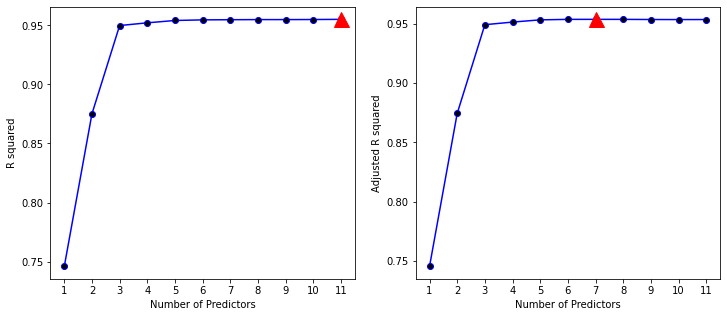
This is not the case for the values of the adjusted . As the Python-output reveals, the adjusted reaches a maximum for seven predictors, after that the values start decreasing.
Using the adjusted results in the selection of the following regression model that was produced by forward selection
Linear Model Selection Example 2.4
The left-hand panel displays the AIC, the right hand panel the BIC.
# Create figure
fig = plt.figure(figsize = (12, 5))

# Plot AIC
ax1 = fig.add_subplot(1, 2, 1)
ax1.plot(results.loc[:, 'AIC'], 'b-',
         marker='o', markerfacecolor='black')
ax1.plot(np.argmin(results.loc[:, 'AIC']),
         np.min(results.loc[:, 'AIC']),
         'r^', markersize=15)
ax1.set_ylabel('AIC')
ax1.set_xlabel('Number of Predictors')


# Plot BIC
ax2 = fig.add_subplot(1, 2, 2)
ax2.plot(results.loc[:, 'BIC'], 'b-',
         marker='o', markerfacecolor='black')
ax2.plot(np.argmin(results.loc[:, 'BIC']),
         np.min(results.loc[:, 'BIC']),
         'r^', markersize=15)
ax2.set_xlabel('Number of Predictors')
ax2.set_ylabel('BIC')

plt.tight_layout()
plt.show()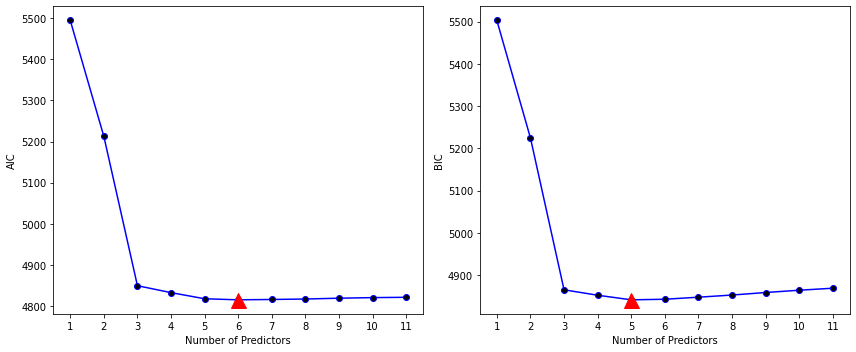
Note that we have to add 1 to the index of the minimum value, as the index starts at 0, whereas the number of predictors starts at 1.
According to the AIC criterion, the best among all models produced by forward stepwise selection contains six predictor variables.
print(np.argmin(results.loc[:, 'AIC']) + 1)6
The (last) Python-output of displays the six predictors of the best model produced by forward selection.
Linear Model Selection Example 2.5
If we want to find the best among all models produced by stepwise forward selection, that is, if we want to identify the most appropriate number of predictors on the basis of the AIC, we only have to repeat the known procedure, for the number of Predictors. Note that the parameter scoreby is now set to AIC.
import pandas as pd
import numpy as np
from LMS_def import *

# Load data
df = pd.read_csv('Linear Model Selection/data/Credit.csv')

# Convert Categorical variables
df = pd.get_dummies(data=df, drop_first=True,
                    prefix=('Gender_', 'Student_',
                            'Married_', 'Ethnicity_'))

x_full = df.drop(columns='Balance')
y = df['Balance']

results = pd.DataFrame(data={'Best_Pred': [], 'AIC':[]})

# Define the empty predictor
x0 = [np.zeros(len(y))]

x = x0
x_red = x_full.copy()

for i in range(x_full.shape[1]):
    results_i, best_i = add_one(x_red, x, y, scoreby='AIC')

    # Update the empty predictor with the best predictor
    x = np.concatenate((x, [df[best_i]]))

    # Remove the chosen predictor from the list of options
    x_red = x_red.drop(columns=best_i)

    # Save results
    results.loc[i, 'Best_Pred'] = best_i
    results.loc[i, 'AIC'] = results_i['AIC'].min()

print('Best Predictors and corresponding AIC:\n', results,
      '\n\nThe best model thus contains',
      results['AIC'].argmin() + 1, ' predictors')
Best Predictors and corresponding AIC:
Best_Pred AIC
0 Rating 5494.781548
1 Income 5212.557085
2 Student__Yes 4849.386992
3 Limit 4832.524008
4 Cards 4817.666820
5 Age 4815.038963
6 Gender__Female 4815.900560
7 Unnamed: 0 4817.004037
8 Ethnicity__Asian 4818.286694
9 Married__Yes 4819.562597
10 Ethnicity__Caucasian 4820.935924
11 Education 4822.448073
The best model thus contains 6 predictors
Linear Model Selection Example 2.6
The right-hand panel displays the BIC for the Credit data set. For instance, the BIC values result from subtracting the BIC of the null model.
Based on the BIC values displayed in the Python-output, we conclude that the best model produced by forward stepwise selection contains five predictor variables.
The Python-output in the previous example shows that the best model produced by forward stepwise selection and containing five predictors is given by
import pandas as pd
import numpy as np
from LMS_def import *

# Load data
df = pd.read_csv('Linear Model Selection/data/Credit.csv')

# Convert Categorical variables
df = pd.get_dummies(data=df, drop_first=True,
                    prefix=('Gender_', 'Student_',
                            'Married_', 'Ethnicity_'))

x_full = df.drop(columns='Balance')
y = df['Balance']

results = pd.DataFrame(data={'Best_Pred': [], 'BIC':[]})

# Define the empty predictor
x0 = [np.zeros(len(y))]

x = x0
x_red = x_full.copy()

for i in range(x_full.shape[1]):
    results_i, best_i = add_one(x_red, x, y, scoreby='BIC')

    # Update the empty predictor with the best predictor
    x = np.concatenate((x, [df[best_i]]))

    # Remove the chosen predictor from the list of options
    x_red = x_red.drop(columns=best_i)

    # Save results
    results.loc[i, 'Best_Pred'] = best_i
    results.loc[i, 'BIC'] = results_i['BIC'].min()

print('Best Predictors and corresponding BIC:\n', results,
      '\n\nThe best model thus contains',
      results['BIC'].argmin() + 1, ' predictors')
Best Predictors and corresponding BIC:
Best_Pred BIC
0 Rating 5502.764477
1 Income 5224.531479
2 Student__Yes 4865.352851
3 Limit 4852.481331
4 Cards 4841.615607
5 Age 4842.979215
6 Gender__Female 4847.832276
7 Unnamed: 0 4852.927218
8 Ethnicity__Asian 4858.201340
9 Married__Yes 4863.468707
10 Ethnicity__Caucasian 4868.833498
11 Education 4874.337112
The best model thus contains 5 predictors
If we want to identify the best model by backward stepwise selection, then we can use the same procedure as before:
results = pd.DataFrame(data={'Worst_Pred': [], 'BIC':[]})

# Define the full predictor
x = x_full.copy()

for i in range(x_full.shape[1]):
    results_i, worst_i = drop_one(x, y, scoreby='BIC')

    # Update the empty predictor with the best predictor
    x = x.drop(columns=worst_i)

    # Save results
    results.loc[i, 'Worst_Pred'] = worst_i
    results.loc[i, 'BIC'] = results_i['BIC'].min()

print('Worst Predictors and corresponding BIC:\n', results,
      '\n\nThe best model thus contains',
      x_full.shape[1] - results['BIC'].argmin(), ' predictors')
Worst Predictors and corresponding BIC:
Worst_Pred BIC
0 Education 4868.833498
1 Ethnicity__Caucasian 4863.468707
2 Married__Yes 4858.201340
3 Ethnicity__Asian 4852.927218
4 Unnamed: 0 4847.832276
5 Gender__Female 4842.979215
6 Age 4841.615607
7 Rating 4840.658660
8 Cards 4873.759072
9 Student__Yes 5237.176925
10 Income 5507.965562
11 Limit 6044.702777
The best model thus contains 5 predictors